
Twice-daily brushing, perhaps flossing most nights, and a coated tongue and smelly breath anyway. Sound familiar?
You only get inward cleaning with a toothbrush. It avoids the bacteria that cluster around your gums and under your tongue, or at the back of your throat, and are involved with gum disease and the drowsy, lousy feeling that conceals one is senses before the morn and chai has reached him. But when you give that bacteria bag all too much room to start its business, it begins to proliferate.
This was a problem that Ayurveda had ironed out well before modern dentistry existed. Ayurvedic oil pulling is a swish-and-spit process that removes bacteria from your mouth using a spoonful of oil, and it's one of the first practices taught in any serious Ayurveda course in India. Now you know what it is actually doing, what you can use to make it work for you, and how to do the job properly on your first attempt.
Table of Contents
- What Is Ayurvedic Oil Pulling?
- What Happens When You Swish Oil in Your Mouth?
- What Are the Real Benefits of Ayurvedic Oil Pulling?
- Which Oil Should You Use?
- How to Do Ayurvedic Oil Pulling: Step by Step
- When Should You Practice It?
- Mistakes That Make Ayurvedic Oil Pulling Less Effective
- Is Oil Pulling Backed by Science?
- How Oil Pulling Fits Into a Bigger Ayurvedic Routine
What Is Ayurvedic Oil Pulling?

Oil pulling is one of the oldest practices in Ayurvedic texts, the Charaka Samhita and the Sushruta Samhita, both composed more than 1,000 years ago. There are two sets of texts that describe two practices, not the same thing.
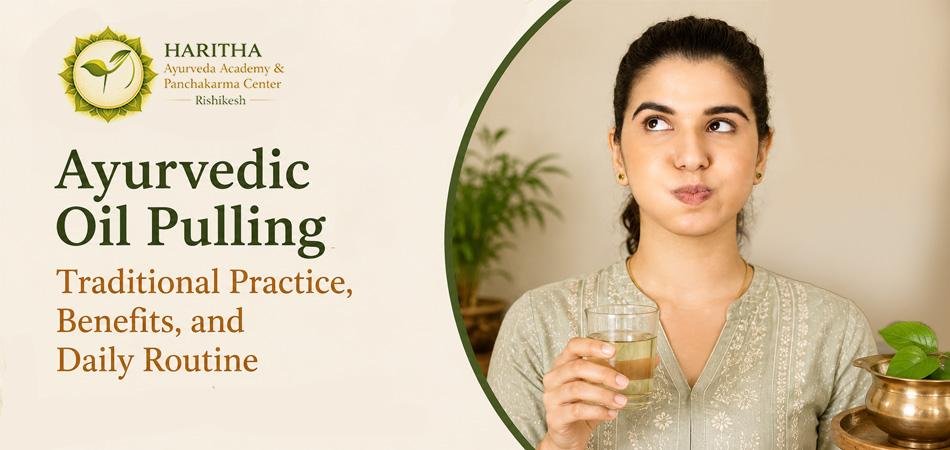
Today, people refer to oil pulling as Kavala Graha. Take an amount of oil that is comfortable for you, swish it vigorously through your teeth and around your gums, then spit it out in a few minutes.
Kavala Gandusha is also slower and less popular. You swallow the oil so thoroughly that you do not have to swish it. You just hold the oil in your mouth until your eyes water or your nose runs. The Ayurvedic texts state that this indicates the treatment is effective.
When reading the rest of this guide, you should imagine the swishing version you see in the kavala graha photo, unless a practitioner advises you otherwise.
What Happens When You Swish Oil in Your Mouth?
Many hundreds of bacterial species live in your mouth, some are helpful, and others are not. A bacterial cell has a fatty membrane that surrounds it, and fat attracts fat. Oil rubs up against saliva as you swish, absorbing bacteria, food particles, and dead cells along the way. That is the reason it turns color and gets watered down as you proceed. Ayurveda refers to this stagnation as Ama (toxin accumulation), and, in simple terms, it is oral gunk that you are ridding yourself of before it turns into plaque.
When finished, the oil should be thin and milky-white and not thick and yellow. If you do not get there, that means you should have taken another step.
What Are the Real Benefits of Ayurvedic Oil Pulling?
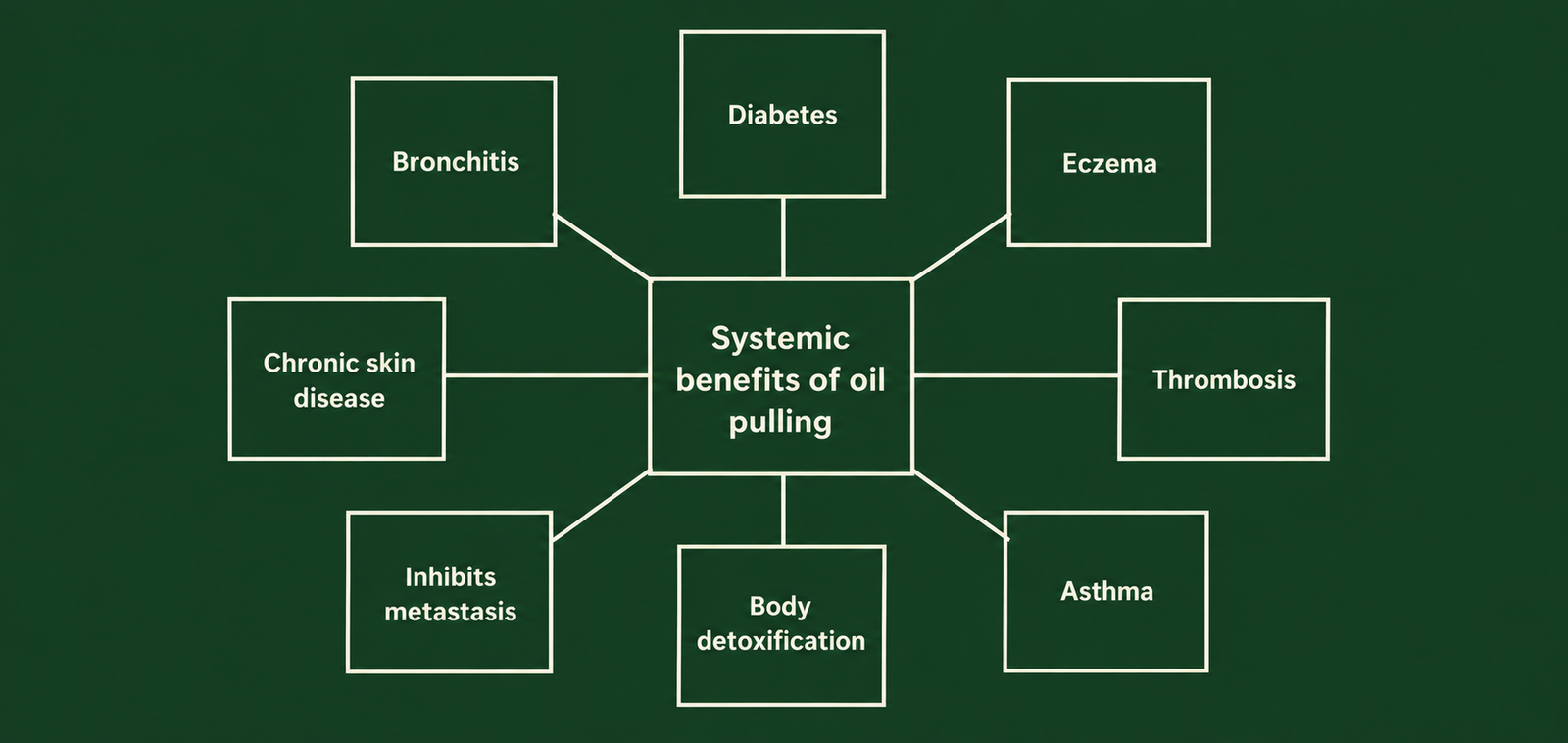
It decreases bacteria and plaque. This is the benefit that has the most research experience. In one clinical study, those who used sesame oil to rinse their mouths each day for about six weeks typically reduced bacterial levels by about 19% and decreased the severity of their cavities. Other research shows that Ayurvedic Oil Pulling is nearly as effective as the prescription mouthwash chlorhexidine in reducing the amount of certain bacteria that can lead to tooth decay.
Can refresh breath. Most chronic halitosis (bad breath) results from bacteria acting on food debris and releasing sulfur compounds. When you are doing oil pulling, you are likely to notice that there is less odor as there are fewer bacteria involved.
May help to sustain gum tissue. Gum recession is a long-term problem caused by dryness, which can be alleviated by allowing the gum tissue to get some moisture and a mild massage from the swishing for a few minutes.
It is associated with improved sinus changes, however, there is limited evidence. Thanks to Ayurveda, the mouth and sinuses are considered two interconnected tissues, and oil pulling is traditionally used to relieve the urge to clear your throat in the morning. There is not much clinical research on this particular claim, so it is better considered a traditional use than a proven use.
An Ayurveda course in India is related to a more peaceful mind and jaw, as well as the tongue. In Ayurveda, tension, overthinking, or heat accumulating in the head and neck are described as excess Pitta, Vata, and Kapha. Practitioners describe oil pulling as pacifying excess Pitta, Vata, and Kapha in the head and neck. Note that this is a traditional framework, it is not a clinical finding, but you should be aware of it if you find it in an Ayurveda course in India.
Not very costly and safe. This requires a spoonful of oil that you most likely have in your kitchen.
Also Read: Complete Guide to Vata, Pitta & Kapha
Which Oil Should You Use?
|
Oil |
Why people choose it |
|
Sesame |
The traditional first choice in Ayurveda, sometimes called the "King of Oils." Rich in antioxidants and considered suitable for most body types. |
|
Coconut |
Contains lauric acid, which has documented antibacterial properties. Milder taste than sesame, which makes it an easier starting point for beginners. |
|
Sunflower |
A lighter, more neutral-tasting option. Some research shows it helps specifically with plaque-related gum inflammation. |
|
Olive |
Less common for pulling but occasionally used for its anti-inflammatory properties. |
Whatever you choose, get a fresh, unrefined, and cold-pressed one. This is all the better processed into a refined oil, in which most of the beneficial components have been removed during processing, thereby rendering it useless.
How to Do Ayurvedic Oil Pulling: Step by Step
- Ideally, do this immediately upon waking, without food or water.
- Put about one tablespoon of oil in your mouth. Less if too much initially, if a bite is simply too much, provide less.
- Swish lightly, moving the oil in your teeth and around the gums. Be careful not to tilt your head back or gargle with it. Your jaw should not be tired, but it should feel relaxed.
- Continue for 10 to 20 minutes. New to this? Begin by reading for 3 to 5 minutes, and increase this over several weeks. You do not have to be a failure if you are given what is right and choose not to take it. Even the initial choice to not take what is right does not make us a failure.
- Put the oil in the garbage, not the sink or toilet, because it can cause a blockage in the pipes over time.
- Rinse out with hot water before brushing your teeth.
When Should You Practice It?
The typical time for dinacharya or the Ayurvedic morning routine is on an empty stomach, in the morning. It is not as effective if you do it later in the day, after meals, because you will be swishing around food debris instead of starting with a relatively clean mouth.
It is generally recommended at this time, as most Ayurvedic protocols suggest doing tongue scraping first, followed by oil pulling, and finally brushing your teeth. A few people like to brush before using oil, as it does not disturb the beneficial bacteria that accumulate on your teeth throughout the night. What is important is that you will use either, but not that you will use one before the other, just use it in the order you do.
Mistakes That Make Ayurvedic Oil Pulling Less Effective
There are a few spikes and troughs to the benefit that are simply undone:
- Swallowing the oil. Now it is carrying the debris from your bacterial surgery, which you were trying to eliminate. Unless it occurs by chance, one time, it may not be dangerous, but do make it a habit to spit.
- Stopping too early, too often! A few minutes of swishing have little impact on the needle. Oil takes several days to become thin enough for bacteria to enter.
- Carried out following meals. Having food waste and a full tummy helps you forfeit most of the point.
- Cooking meals with perfumes or refined cooking oils. Store sesame or coconut oil intended for pulling, and do not use the oil next to the stove used for frying.
- Assuming it can be used as a substitute for brushing and flossing. In traditional Ayurvedic methods, oil pulling is just one component of an oral hygiene regimen, and not the oral hygiene itself.
Is Oil Pulling Backed by Science?
This is a question to which you must be honest. Some small clinical trials have shown beneficial effects on oral bacteria and plaque. One study showed that Ayurvedic Oil Pulling was as effective as chlorhexidine mouthwash. That is some truly positive early findings.
Meanwhile, dental associations, such as the American Dental Association, are not, at this time, recommending oil pulling over brushing and flossing, primarily due to limited robust research to date and the short duration of the studies. While some ancient Ayurvedic literature suggests that oil pulling detoxifies the whole body or heals a dozen different ailments, these claims lack scientific evidence.
The sensible middle ground is that oil pulling is seemingly helpful as an additional weapon in your oral care arsenal, neither a remedy nor a brush replacement.
Reserch: Oil pulling and importance of traditional medicine in oral health
How Oil Pulling Fits Into a Bigger Ayurvedic Routine
Oil pulling is rarely practiced on its own in Ayurveda. It is one of the Dinacharya, which consists of scrubbing the tongue, self-massage with oil, and eating according to your constitution. The moment you have been playing for a while and find yourself going a little deeper in the game because you are curious is possibly one of the best indicators that you are ready for something more than a home game that you have practiced from blogs.
That is exactly the kind of preparation that happens at the beginning of a Ayurveda course in India that might be there in India where perhaps it would be taught that not only are they going to teach you how to pull oil, they are going to teach you the logic behind how they is come up with the recommendation to pull with this rather than that oil, and what the logic is behind pulling in this fashion rather than that. That is the next step for anyone wishing to take their own further ahead, rather than merely following instructions.






Comments (0)