
You have tried a "healthy" diet and started cutting out sugar, eating salads, maybe even intermittent fasting. But you are still full after lunch, or exhausted by 4 pm, or wide awake at midnight instead of sleeping.
The problem is, a food plan designed for the average person is not designed for you. Smoothies and raw salads may help others, but the same meal leaves you bloated, cold, and drained by evening. That is not a willpower problem, but a sign the food do not match your body type.
This is where a dosha-based Ayurvedic diet comes in. Ayurveda, the traditional Indian system of health, holds that every person is made up of three energies called doshas, like Vata, Pitta, and Kapha. Once you know which one drives your body, you know exactly which foods will keep you steady and which ones will throw you off balance.
Here is a complete Vata, Pitta, and Kapha diet breakdown to help you build an Ayurvedic diet suited to Vata, Pitta, or Kapha.
Table of Contents
- What Is a Dosha?
- How Do You Know Your Dosha?
- The Six Tastes: Ayurveda's Real Building Block
- Ayurvedic Diet for Vata
- Foods to Favor
- Foods to Limit
- A Sample Vata Day
- Ayurvedic Diet for Pitta
- Foods to Favor
- Foods to Limit
- A Sample Pitta Day
- Ayurvedic Diet for Kapha
- Foods to Favor
- Foods to Limit
- A Sample Kapha Day
- What If You Are Two Doshas at Once?
- The Verdict
What Is a Dosha?
Think of doshas as the pattern your body runs on.
Vata is the energy of movement. It powers your nerves, your breathing, and your digestion. Vata types tend to be thin, quick-thinking, and easily excitable, and just as easily thrown out of balance.
Pitta is the energy of transformation and heat. It governs your metabolism and your temper. Pitta types usually have a sharp metabolism, get hungry right on schedule, and can run hot, literally and emotionally.
Kapha is the energy of body. It controls your physical stability, the health of your joints, and the strength of your immune system. Kapha body types tend to be sturdy, calm, and slower to digest.
Almost no one is a single pure type, which is exactly why a one-size-fits-all Ayurvedic diet rarely works for long. Most people are a combination, with one or two doshas driving most of their energies. That combination is set at birth, but life with stress, weather, food choices can push one dosha out of balance on any given day. That is when you notice the symptoms like, bloating, breakouts, anxiety, laziness.
Read More about: Three Doshas in Ayurveda: Complete Guide to Vata, Pitta & Kapha
How Do You Know Your Dosha?
You do not need a lab test for this. The traditional way to identify your dosha in Ayurveda is by looking at body build, digestion, and temperament. Here is a quick way to spot your leading dosha:
|
Sign |
Vata |
Pitta |
Kapha |
|
Body frame |
Thin, light |
Medium, athletic |
Solid, broad |
|
Skin |
Dry, cool |
Warm, prone to redness |
Oily, smooth |
|
Appetite |
Irregular |
Sharp, gets irritable if hungry |
Steady, can skip meals easily |
|
Sleep |
Light, easily disturbed |
Moderate, sound |
Deep, heavy |
|
Under stress |
Anxious, restless |
Irritable, short-tempered |
Withdrawn, sluggish |
|
Weather that bothers them most |
Cold and wind |
Heat and sun |
Cold and damp |
The Six Tastes: Ayurveda's Real Building Block
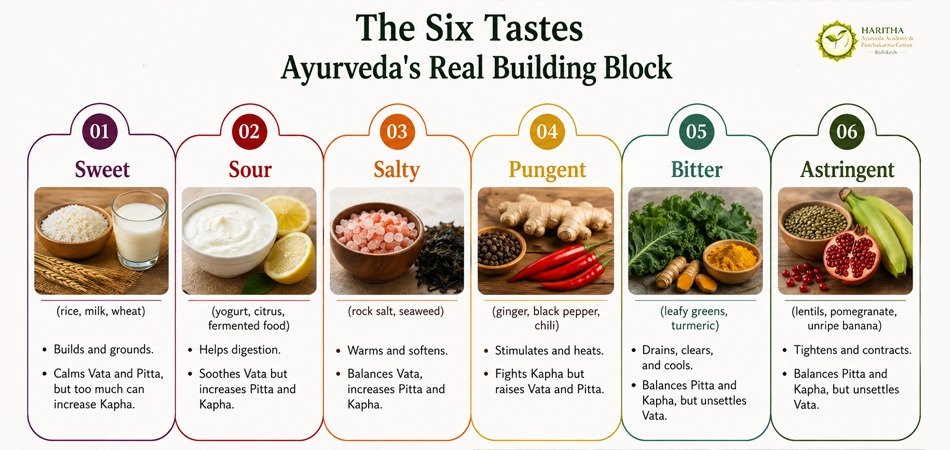
Most food guides skip the reasoning and just hand you a list of what to eat and what to avoid. Ayurveda works differently, as it sorts food by taste, not calories. Every food carries one or more of six tastes, and each taste raises or lowers a specific dosha. This is the real logic behind any Vata Pitta Kapha diet, and once you understand the tastes, the food lists below stop feeling random.
- Sweet (rice, milk, wheat): builds and grounds. Calms Vata and Pitta, but too much can increase Kapha.
- Sour (yogurt, citrus, fermented food): helps digestion. Soothes Vata but increases Pitta and Kapha.
- Salty (rock salt, seaweed): warms and softens. Balances Vata, increases Pitta and Kapha.
- Pungent (ginger, black pepper, chili): stimulates and heats. Fights Kapha but raises Vata and Pitta.
- Bitter (leafy greens, turmeric): drains, clears, and cools. Balances Pitta and Kapha, but unsettles Vata.
- Astringent (lentils, pomegranate, unripe banana): tightens and contracts. Balances Pitta and Kapha, but unsettles Vata.
You do not need to memorize this chart to eat well.
Ayurvedic Diet for Vata
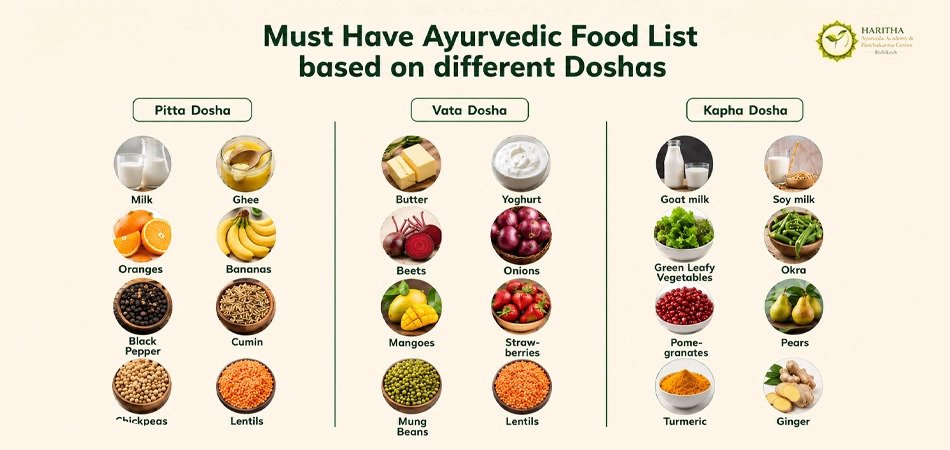
Vata is dry, light, cool, and quick by nature. So an ayurvedic diet for Vata works by opposite qualities, with foods that are warm, moist, and grounding.
Foods to Favor
- Rice, oats, wheat
- Sweet potato, carrot, beet
- Milk, ghee, warm paneer
- Banana, mango, soaked dates
- Ginger, cinnamon, cumin
- Nuts and seeds, soaked overnight
Foods to Limit
- Ice-cold smoothies and raw salads
- Dry, crunchy snacks like crackers and popcorn
- Carbonated drinks
- Undercooked or unspiced beans and lentils
- Excess caffeine
A Sample Vata Day
Breakfast should have warm oats cooked in milk, with soaked almonds and a sprinkle of cinnamon. Lunch should have kichdri, that is soaked rice and softened mung dal, garnished with ghee. Dinner will be a warm, lightly spiced vegetable soup, eaten early.
For Vata, it is not just what is on the plate that matters. Warmth and regular timing matter just as much as the food itself.
Ayurvedic Diet for Pitta
Pitta already runs hot. The goal of an Ayurvedic diet for Pitta is not to add more heat, but to cool things down without slowing digestion, which Pitta types usually handle just fine.
Foods to Favor
- Melon, grapes, pear
- Cucumber, leafy greens, zucchini
- Fresh coconut or coconut water
- Basmati rice, barley
- Honey in small amounts
- Ghee, in moderate quantity
Foods to Limit
- Chili, garlic, and very spicy food
- Sour and fermented foods like vinegar and pickles
- Excess salt
- Red meat and fried food
- Alcohol and strong coffee
A Sample Pitta Day
Breakfast should contain fresh fruit with a handful of soaked raisins. Lunch should be consisting of steamed greens with cucumber raita and basmati rice, the largest meal of the day, since Pitta digestion peaks midday. Dinner should be something light, with vegetables, mint, and coriander, eaten well before bed.
Pitta types do best avoiding heavy food in the peak heat of the day and steering clear of arguments around mealtimes, inner heat and outer heat feed off each other.
Ayurvedic Diet for Kapha
Heavy, slow, and steady by nature, Kapha needs the opposite. An Ayurvedic diet for Kapha works by favoring food that is light, warm, and stimulating, so digestion does not slow down further.
Foods to Favor
- Barley, millet, quinoa
- Lentils, chickpeas
- Spinach, kale, fenugreek
- Turmeric, black pepper, ginger
- Apples, pomegranate, berries
- Honey in small amounts, never heated
Foods to Limit
- Heavy or cold dairy, especially full-cream milk and cheese
- Fried and oily food
- Sweet, heavy desserts
- Excess wheat and rice
- Cold drinks and cold food in general
A Sample Kapha Day
Breakfast can be something light, or a spiced herbal tea, since Kapha digestion is often slow to wake up. Lunch, the main meal should have a bowl of spiced lentils with sauteed greens. Dinner should contain a small serving of warm vegetables with black pepper and ginger.
For Kapha types, lighter meals paired with more movement, especially in the morning, make the biggest difference, since Kapha energy peaks early in the day.
What If You Are Two Doshas at Once?
Most people are not a single pure type, they are Vata-Pitta or Pitta-Kapha combinations. When that is the case, eat for whichever dosha is currently out of balance, not the one that is already fixed. If you are breaking out and short-tempered, eat for Pitta, even if you are technically Vata-Pitta. Once that settles, shift toward whatever the next dosha needs. In Ayurveda, this was never meant to be a fixed label, it is rather something that change with you.
The Verdict
A dosha diet in Ayurveda is not complicated or built on rare ingredients. The whole idea is to eat things that carry the opposite quality of whatever is already too strong in you.
Vata needs warmth and grounding. Pitta needs cooling and moderation. Kapha needs lightness and stimulation. None of this is about strict rules, it is about paying attention.
Start by finding your dominant dosha using the table above, then adjust one meal at a time, and track how you feel over a few weeks rather than a few days. If you have a diagnosed health condition, talk to an Ayurvedic experts or doctor before making major changes, this ayurvedic food diet approach is meant to support medical care, not replace it.











Comments (0)